Punks on the Internet: Sontag, Swift, and Her Cynics

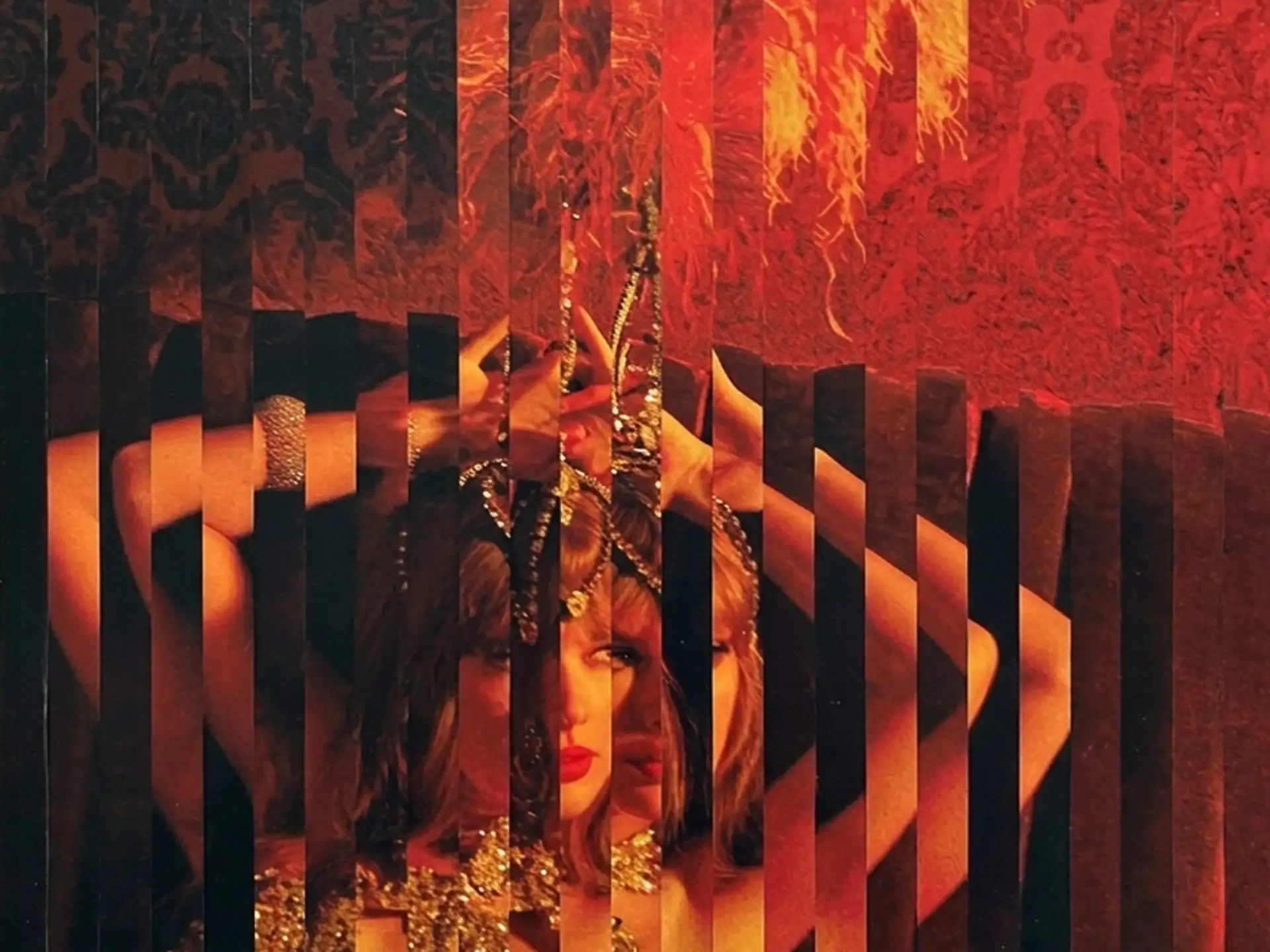
On a Thursday evening in October 2025, my girlfriends and I packed into the narrow living room of my East Village apartment to observe our highest holy day: The release of a new Taylor Swift album.
The Life of a Showgirl was set to drop at midnight. The past few hours we’d devoured cheeseboards and exchanged predictions about what Swiftian Easter eggs the mysterious tracks may hold. Drunk on boxed wine and spilled gossip, we squeezed between futon arms and prepared to receive the good word as the clock struck TS12.
From the silence emerged a pensive piano. Our eyes widened in recognition—there was a haunting resemblance to “The Manuscript,” the closing ballad of Swift’s last album, The Tortured Poets Department. But, after a breath, isolated chords gave way to a confident synth beat—a sigh of relief. We’d escaped the sepia melancholy of heartbreak and arrived in the Showgirl era.
The next 42 minutes flashed by as the sugar rush of TLOAS hit our veins. Polaroids captured us head-banging to the pulse of “Elizabeth Taylor,” twirling in the effervescence of “Opalite,” and giggling at the innuendos strung throughout “Wood.” In the quieter moments of “Eldest Daughter” and “Honey,” we topped off our plastic glasses, savoring the irreplicable bliss of an inaugural listen.
The final track, “The Life of a Showgirl,” waved goodbye with a nostalgia-inducing send-off from the Eras tour’s closing performance. Swift’s voice echoed through a packed stadium: “Thank you for an unforgettable night.” As the phantom cheers faded to silence, a sparkly static lingered in the air.
“Sooooo?”
The end of the album brought forth a sound just as welcome to my ears: An intoxicating (and by this point, intoxicated) harmony of voices chattering about Taylor Swift. Friends along a spectrum of Swiftiehood chimed in with their first-impression favorites. Between the twelve of us, top-choice picks spanned almost every song on the album. There was something for everyone, it seemed, as fresh Max Martin beats pulsed beneath the conversation. Despite entering the early hours of the morning, we thrummed with energy, making plans to attend an upcoming Taylor Swift dance party and scrolling Pinterest for showgirl-inspired halloween costumes. TLOAS had created momentum, but we were too busy enjoying it to debate how or why. Our verdict was obvious: The Life of a Showgirl was a roaring success.
The morning after the TLOAS drop, I woke up to an empty apartment and a blooming hangover. Unwilling to face the party’s ruins, I popped an Advil and opened my phone, eager to tap the well of fresh #SwiftTok content awaiting me.
As expected, my feed was ablaze with the album’s signature orange glitter—but the sentiments were less than sparkling. Video after video, creators echoed critiques, stating that it was Swift’s worst album, that the production was sloppy, the lyrics inane. The takes got hotter the deeper I scrolled: These lyrics are MAGA-coded! Taylor Swift is a #tradwife! This whole album is conservative propaganda! Reactions spanned from disappointment to disgust, even from the most fervent of Swifties. The discourse sucked me into its algorithmic whirlpool, temporarily replacing my hangover-induced nausea with a more cerebral malaise.
I groaned and pried myself out of bed. “Alexa, play The Life of a Showgirl on Spotify.”
The living room was in shambles. Sunlight revealed smudged glasses and empty wine bottles. I winced at the coil of pain tightening in my forehead.
“Alexa, volume down,” I croaked.
“The Fate of Ophelia” softened a touch. I dragged a Swiffer across the living room, wondering if the empty hardwood floor was hollowing out the sound. As the album progressed, the comment section complaints stuck to me like burs: Maybe “I’m not a bad bitch” is a stupid line. Maybe we didn’t need that diss about Charli XCX’s cocaine habit.
It wasn’t the first wave of anti-Swift rhetoric to flood my social channels, but it was the first strong enough to pull me under. In the past, much of the criticism directed at Swift’s music struck me as deeply (or not so deeply) rooted in misogyny, making it easy to write off. But within the new crop of critics on my TikTok feed, a few caught my attention. They seemed to be making educated arguments—capitalism corroding the music industry, repressive femininity infiltrating media aimed at young women—the kind of stuff I may have nodded along with had it not been aimed at my all-time favorite artist. Was I too blinded by devotion to recognize the harsh truth? Perhaps becoming a billionaire WAG had dulled the sharp wit that defined Swift’s earlier eras. Or maybe a harsher reality was becoming clear: Maybe she was never that good to begin with.
Susan Sontag argued that making sense of art and the world producing it can come at the expense of the art itself. In her seminal essay, Against Interpretation, she posits that the project of interpretation has evolved beyond utility. Rather than bringing us closer to art, contemporary interpretation, as Sontag saw it, created more distance, making it increasingly difficult to derive any sort of pleasure. “Like the fumes of the automobile and of heavy industry which befoul the urban atmosphere,” she writes, “the effusion of interpretations of art today poisons our sensibilities.”
Our experience may be pleasurable, frightening, challenging, or evening boring. What matters is that it’s our experience, not a reproduction of someone else’s.
Perhaps Sontag drew this comparison from the smog-choked streets of Manhattan she called home. While New York has undergone enormous change in the decades between Sontag and myself, I like to imagine our experiences of the city have some parallels. She must have walked past a similarly dizzying barrage of advertisements, marquis, and newsstands proclaiming conflicting versions of reality in the same bold typeface. The classrooms and auditoriums she entered teemed with the same impassioned reactions that became central to her argument. “The conditions of modern life—its material plenitude, its sheer crowdedness—conjoin to dull our sensory faculties,” she writes. I imagine after long days of engaging her mind, Sontag craved to engage her senses. This is why she so often braved the rat-ridden streets in search of escape. In search of art.
Favoring feeling would have distinguished Sontag from her equally erudite peers. At the time, frameworks provided by Marxism and Freudianism dominated conversations, subjecting art to a sort of “excavation,” as Sontag put it, that ultimately “destroys.” What’s left is more a comfortable, palatable understanding, but the art itself has lost its purpose. In its place is what Sontag calls a “shadow world of meanings,” where sensation is superseded by analysis.
The project of interpretation has since evolved and adapted, trickling down from 1960s literary salons to TikTok comment sections. To post something online—be it an essay, an Instagram dump, or a Showgirl-themed pop album—is to invite public criticism. And without the barriers of publishing or even editing between critics and platforms, the language of critique has grown more reactionary and less articulate. The “aggressive and impious theories of interpretation” bemoaned by Sontag persist in the form of typo-riddled ramblings and copy-pasted platitudes. It doesn’t require an understanding of Marx to comment there are no ethical billionaires under capitalism!!!! on a TLOAS Reddit thread. But the impulse is the same: To “tame” the work of art.
Take, for example, various interpretations of “The Fate of Ophelia,” TLOAS’s opening track. The most scathing analyses I’ve encountered come from self-proclaimed Shakespearean scholars dissecting inconsistencies between the pop single and Hamlet. The song engages the classic Swiftian trope that drove “Love Story” to global fame—Romeo and Juliet reimagined with a happy ending. These cultural touchpoints evoke fantastical, romantic scenes, inviting audiences to heightened states of imagination. But to remain tethered to a literal reading, to interpret, “takes the sensory experience of the work of art for granted, and proceeds from there.”
“The Fate of Ophelia” might lyrically read like a lazy book report, but the song wasn’t written to be studied in lecture halls. It was written to be danced to. You can feel it from the jump—the enticing snare, the drop of a beat. The tempo quickens your heartbeat and drives the story fearlessly forward. The lyrics are cinematic—a damsel locked in a tower, a sweeping escape over land and sea—while also blending in modern slang like “keep it one hundred” with Shakespearean shorthand, “tis locked inside my memory.” Swift revealed that the inspiration for the song wasn’t the story of Hamlet, but rather the name “Ophelia,” which she selected specifically to compliment the chorus’s sliding crescendo. The vowel switch into a bright “ee” is almost onomatopoeic—a squeal of delight. All these elements alchemize to create the kind of sonic pleasure that burrows into your brain, only to emerge in the grocery line or on the subway platform.
Even if Shakespeare-inspired pop songs don’t do it for you, it’s hard to argue Swift’s musical prowess. She’s one of the most decorated artists of all time. But to some, the music isn’t the problem—it’s the artist herself (see also: “Anti-Hero”.) Swift has gone on to release nine more original albums, sweep the world with the highest-grossing tour of all time, and buy back her entire masters catalogue. As many comment section pundits will be quick to remind you, her empire has surpassed the billion-dollar mark, leaving fans and critics alike doubting the relatability that fueled her earlier work. Their concerns are valid: Swift wields a lot of power in a socially, economically, and politically tumultuous time. There are a lot of frightened eyes looking for solutions, and due to her sheer enormity, many have landed on her. Every move she makes is scrutinized, and every lyrical choice “excavated,” as Sontag would say, to the point that her personal life and artistic output are entirely conflated.
Swift may not be the first artist to experience this kind of visibility, but she’s among the first to do it since the rise of the internet with sustained longevity, making her a unique case study for art criticism in the age of social media. Her debut album was released in 2006, just a few months before Apple’s release of the iPhone, and it’s no coincidence that her meteoric rise has occurred in tandem with the proliferation of social media. CDs evolved to iPods and then to streaming platforms. MySpace gave way to Facebook, Instagram and Twitter. These trajectories move in the same direction: towards increased, instantaneous access.
To engage without the armor of cynicism often feels uncomfortably exposed. The few positive takes on TLOAS I encountered were met with disparagements about the fan’s taste, intelligence, even their appearance. Earnesty does not bode well in a volatile, anonymous landscape. After spending enough time wading through this kind of online discourse, our callouses harden.
Swift cheekily references this cultural predicament on track five of TLOAS, singing about how “Everybody’s so punk on the internet.” These lyrics from “Eldest Daughter” employ internet-speak to convey the apathetic posturing that signals credibility online —“everyone’s unbothered ‘til they’re not.” But as she approaches the chorus, something shifts. She abandons her detached facade and surrenders to emotion, acknowledging the strain of constantly feigning indifference. The bridge provides a swell of visceral imagery: “Ferris wheels, kisses, and lilacs”—sights, smells, and sensations that evoke the innocent novelty of first romance. As the song is ultimately about love: The vulnerability it requires, the conflict it invites.
I believe a similar tension exists between art and audiences: What if the thing that brings me joy, that makes me feel seen, turns out to be a sham? What if I wind up being wrong and looking stupid?
We all come to the table with different tastes and desires that inform our perspective. These preferences are often rooted in nostalgia, born from the shameless childhood enthusiasm Swift writes about in “Eldest Daughter.” My earliest experiences of falling in love with music were shaped by campy showtunes and early-aughts bubblegum pop; I’ve been primed to love TLOAS. And though many fans approached the album with the same raw enthusiasm that I did, not everyone felt a spark.
That’s okay. In fact, it’s what art requires of us. It demands we let our guard down in order to experience it. Only then, like love, can it put us on edge, make our hearts race.
Art will also disappoint us. But if we allow those disappointments to harden us past the point of emotion, past the point of being moved, we’ll never find out what it is that moves us.
In 2026, The New York Times named Taylor Swift among their “30 Greatest Living American Songwriters.” In an accompanying video interview, Swift explained her process and evolution from “Love Story,” to “The Fate of Ophelia.” Her passion is palpable—she speaks of songs as paintings, movies, and novels, using hand gestures and facial expressions to articulate her thoughts. When it comes to her art and the art that inspires her, she’s clearly attuned to the luminousness of the thing. Her shameless enthusiasm seems impossible given the circumstances of a hyper-visible, hyper-criticized life. But in typical Swift fashion, she’s masterminded the problem.
“A public person who makes art is a mirrorball,” she said, addressing her relationship with critics, “however they feel about themselves and their life, will be projected onto how they see you.”
For me, this album brought out my best self. It filled me with a rare, childlike excitement, gathering my friends with the promise of cheeseboards. When folklore dropped in the summer of 2020, it meant dawning a surgical mask and wandering an eerily quiet Central Park with headphones in. Whatever the circumstance, I set the stage. When I shine my brightest light on the mirrorball that is Taylor Swift, it reflects back to me in a sparkling, luminous array.
Our approach to forming impressions may be just as consequential as the art itself. We need to step away from the noise—the fumes of interpretation Sontag warned against—in order to experience art for what it actually is. By entering this open, vulnerable space, we allow ourselves to receive the work. We can soak up its sounds and colors and contours. We can let it affect us. Our experience may be pleasurable, frightening, challenging, or evening boring. What matters is that it’s our experience, not a reproduction of someone else’s. Once we understand what speaks to our unique artistic preferences, we can seek out more. Even create our own.
I don’t know how many times we circled through The Life of a Showgirl’s twelve tracks that Thursday night, only that it wasn’t enough. No one was eager to leave Swift’s diamond-encrusted fantasyland for the subway platform’s screeching cacophony. Inevitably, my friends peeled off one by one, moaning that they should get some sleep before the workday morning ahead. We’d emptied enough bottles to know we’d wake with puffy eyes and headaches. It would be hell.
“But at least,” said the last person to depart, “we’ll have something to listen to.”